

Provident Fund and ESIC are among the most commonly misunderstood compliance obligations for manpower companies. Not because the rules are complicated in principle, but because applying them correctly across a large contract workforce with variable wages, multiple sites, and frequent worker changes creates genuine operational complexity.
This guide gives you a clear, practical explanation of how PF and ESI work for contract workers in India, what the eligibility thresholds are, how to calculate contributions correctly, and what happens when your workers are supplied to a principal employer who may also be making contributions.
We cover both the employer and employee sides of the contribution, the deposit deadlines, and the most common mistakes that trigger notices and penalties.
Who Is Responsible for PF and ESI on Contract Workers
When a manpower company deploys workers to a principal employer, the contractor (manpower company) is primarily responsible for enrolling workers in PF and ESIC and making the required contributions.
However, the CLRA and the relevant statutes also make the principal employer jointly liable. If you fail to deposit contributions on time, or if workers are not enrolled, the principal employer can recover the amounts owed from the money payable to you under your contract and deposit them directly. You lose the amount from your receivables, and the liability remains on record against your establishment.
This joint liability is why many well-run principal employers now require contractors to submit PF and ESIC compliance proof, such as ECR copies and ESIC challans, as part of their monthly billing process.
Provident Fund for Contract Workers
Eligibility
PF under the Employees’ Provident Funds and Miscellaneous Provisions Act, 1952 applies to establishments with 20 or more employees. Once an establishment is covered, all employees earning up to Rs 15,000 per month in basic wages must be enrolled in PF.
For contract workers, this means:
• Every worker whose basic monthly pay is at or below Rs 15,000 must have PF deducted and the employer contribution made
• Workers earning above Rs 15,000 in basic wages have the option to opt out, but if they were previously enrolled and their wages have increased above the threshold, they may choose to continue contributing at Rs 15,000 as the base
• Daily-wage workers must have their monthly basic wages computed before PF eligibility is assessed. Multiply the daily basic rate by 26 (the standard working days) to arrive at the monthly equivalent
Contribution rates
Both the employer and employee contribute at 12% of basic wages each. The employee’s share is deducted from the wages paid to the worker. The employer’s share is an additional cost borne by the company.
Of the employer’s 12%:
• 3.67% goes to the EPF account (Employees’ Provident Fund)
• 8.33% goes to the EPS account (Employees’ Pension Scheme), subject to a ceiling of Rs 1,250 per month (which applies when wages are above Rs 15,000, as 8.33% of Rs 15,000)
How to calculate PF for a daily-wage worker
PF deposit and filing deadlines
- Monthly deposit deadline: 15th of the month following the wage month. June wages must have PF deposited by 15th July.
- ECR (Electronic Challan cum Return): Filed online through the EPFO unified portal at the time of payment. No separate return is required monthly.
- Annual returns: Form 3A and Form 6A are filed annually but have largely been replaced by the monthly ECR system for most establishments.
ESI for Contract Workers
Eligibility
ESIC under the Employees’ State Insurance Act, 1948 applies to establishments with 10 or more employees (in most states) and covers workers earning up to Rs 21,000 per month in gross wages. Unlike PF, the ESIC eligibility is assessed on gross wages, not basic wages.
For contract workers:
- All workers with gross monthly wages at or below Rs 21,000 must be enrolled and covered under ESIC
- Workers earning above Rs 21,000 gross are excluded and should not have ESIC deducted
- Once enrolled, a worker continues under ESIC even if their wages temporarily cross the threshold during a wage revision, until the next contribution period review
Contribution rates
- Employee contribution: 75% of gross wages. Deducted from the worker’s wages each month.
- Employer contribution: 25% of gross wages. Paid by the company in addition to the net wages.
ESIC deposit and filing deadlines
- Monthly contribution deposit: 15th of the following month via the ESIC online portal
- Half-yearly returns: Filed for the April to September period (due by November 12) and the October to March period (due by May 12)
- New worker registration: Workers must be registered within 10 days of joining. ESIC insurance numbers are generated on registration.
PF and ESI Together: The Combined Deduction
Most contract workers are subject to both PF and ESIC. Here is how the deductions stack when both apply:
| Deduction | Employee Rate | Employer Rate | Eligibility Ceiling | Monthly Deposit Deadline |
|---|---|---|---|---|
| Provident Fund (PF) | 12% of basic wages | 12% of basic wages | Basic wages up to Rs 15,000/month | 15th of following month |
| ESIC | 0.75% of gross wages | 3.25% of gross wages | Gross wages up to Rs 21,000/month | 15th of following month (challan); Return quarterly |
When computing net wages for a worker, subtract PF employee contribution and ESIC employee contribution from gross wages. Then also deduct Professional Tax if applicable in your state.
The employer contributions, PF at 12% and ESIC at 3.25%, are over and above what you pay the worker. They are a component of your labour cost per worker and must be built into your pricing and contract rates with principal employers.
Common Compliance Mistakes Manpower Companies Make
Applying PF to gross wages instead of basic wages
PF is calculated on basic wages only. If a worker earns Rs 14,000 in basic and Rs 2,000 in allowances, PF applies to Rs 14,000, not Rs 16,000. Applying PF to the full gross amount overstates both the deduction and the employer contribution, and creates a discrepancy in the ECR filing.
Not enrolling workers immediately on joining
Some contractors delay PF and ESIC registration for new workers to reduce costs during initial deployments. Under both statutes, enrollment is mandatory from the first day of employment once the establishment is covered. Delayed enrollment attracts arrears, interest, and damages.
Not updating workers when wages cross the ESIC ceiling
When a worker’s gross wages cross Rs 21,000 following a wage revision, they move out of ESIC coverage at the start of the next contribution period. If ESIC continues to be deducted after this point, the worker is being incorrectly charged. Your payroll system should flag eligibility changes automatically at each wage revision.
Missing the 15th deposit deadline
PF and ESIC deposits made after the 15th attract interest at prescribed rates. For PF, the interest is 12% per annum on delayed deposits. For ESIC, a simple interest rate applies. Across a workforce of several hundred workers, even one late deposit cycle creates a non-trivial liability.
Not accounting for employer contributions in client billing
The employer PF contribution (12% of basic) and ESIC contribution (3.25% of gross) are costs your company bears over and above the wages you pay workers. If your billing to the principal employer does not account for these costs, you are absorbing them from your margin. At 300 workers, this adds up to a significant monthly amount.
Frequently Asked Questions
Does PF apply to workers on a fixed-term contract?
Yes. Fixed-term contract workers are entitled to PF and ESIC on the same basis as permanent employees. The nature of the employment arrangement does not affect statutory benefit eligibility. If the worker earns within the applicable thresholds, contributions are mandatory.
What happens to a worker’s PF account when they change jobs?
The PF account (UAN) belongs to the worker and is portable across employers. When a worker moves from one deployment to another, their UAN remains the same. As their employer, you contribute to their existing UAN. Workers who have gaps in contributions between jobs do not lose their accumulated balance.
Can a principal employer check whether we have deposited PF and ESIC?
Yes. Principal employers can verify PF deposits through the EPFO employer portal using your establishment code. ESIC deposits can be verified through the ESIC employer login. Many large principal employers now routinely check compliance status before releasing monthly payments to contractors.
What if a worker refuses to contribute to PF?
A worker who earns above Rs 15,000 in basic wages can opt out of PF. A worker earning within the threshold cannot refuse. If you have already enrolled a worker in PF, they cannot unilaterally stop contributions. The deduction is mandatory.
How does EyeQHR handle PF and ESIC for contract workers?
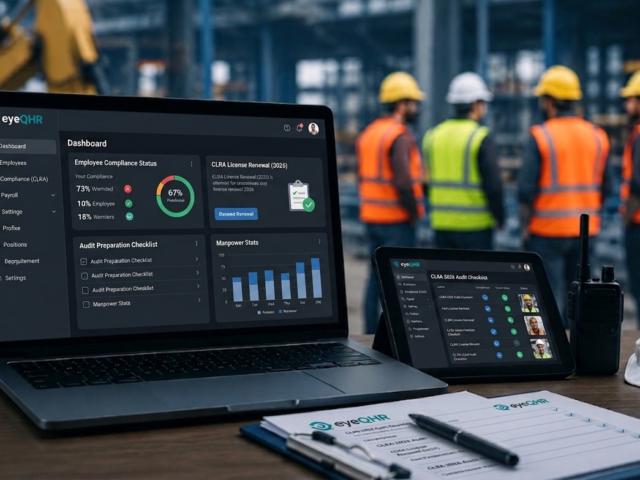
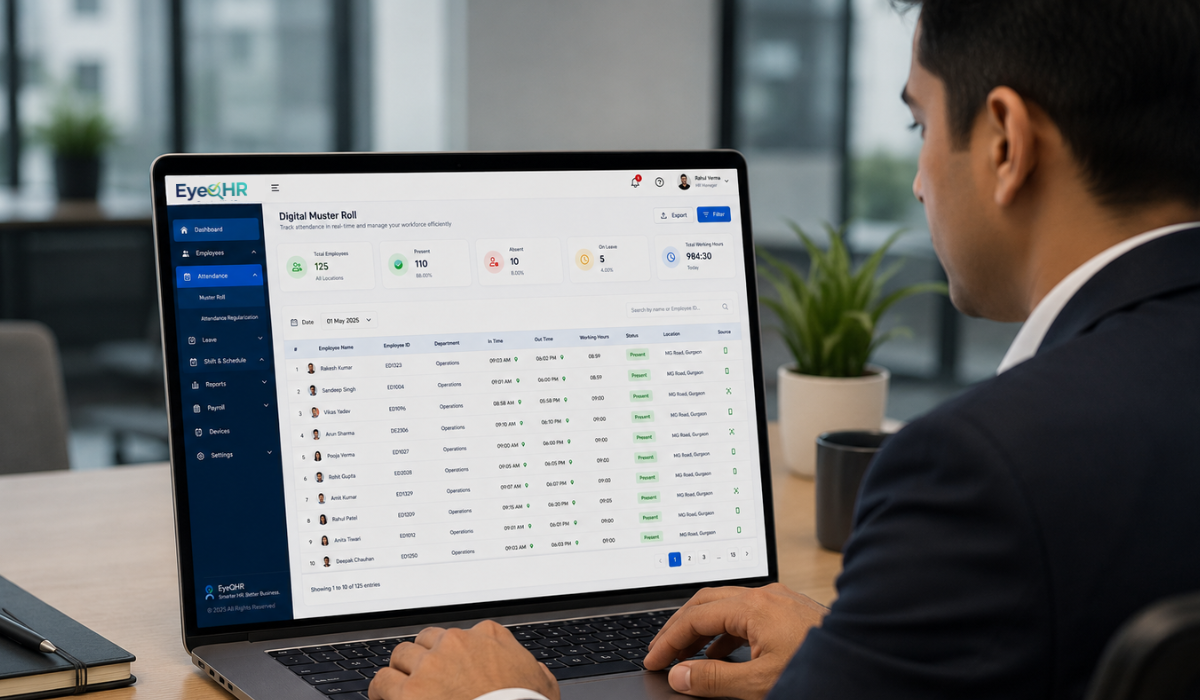
EyeQHR automatically checks each worker’s eligibility against the PF and ESIC thresholds on every payroll run. It applies contributions to the correct wage components, flags any workers whose wages have crossed a threshold during the month, generates the ECR file for EPFO upload, and produces a deduction summary that matches what appears on each worker’s payslip.
Final Notes
PF and ESIC compliance for contract workers comes down to two things: applying the right rate to the right wage component, and depositing on time every month. The rules are clear. The complexity for manpower companies comes from doing this correctly across hundreds of workers with different wage levels, different joining dates, and different deployment histories.
Any manpower company processing payroll for more than 50 contract workers should have a system that checks eligibility automatically and generates the ECR and ESIC challans directly from payroll data. Manual calculation at that scale is where errors accumulate.