

Why Contract Labour Management Software is Non-Negotiable for India’s Manpower Industry in 2026

If you run a manpower company, staffing agency, or security firm in India, you already know that managing contract labour is nothing like managing a regular office workforce. Workers are spread across client sites, wages change with attendance, compliance requirements pile up every month, and one missed filing can put your contractor licence at risk. The companies that still handle all of this manually in spreadsheets and WhatsApp groups are not just inefficient. They are carrying a risk they cannot see.

That is precisely why contract labour management software in India has moved from a nice-to-have to an operational necessity. This guide breaks down what the software actually does, what it costs you when you operate without it, and what to look for when you evaluate platforms in 2026.

What Contract Labour Management Software Actually Does

The term gets used broadly, so it is worth being specific. Contract labour management software is an integrated platform that handles the complete lifecycle of deploying and paying contract workers — from onboarding and site assignment through to payroll, statutory compliance, and exit.

At its core, the software manages four functions that most manpower companies currently handle across separate, disconnected tools:

  • Workforce deployment and tracking: Workers are assigned to client sites with start dates, shift types, and applicable wage rates. The system tracks who is where at any point in time.
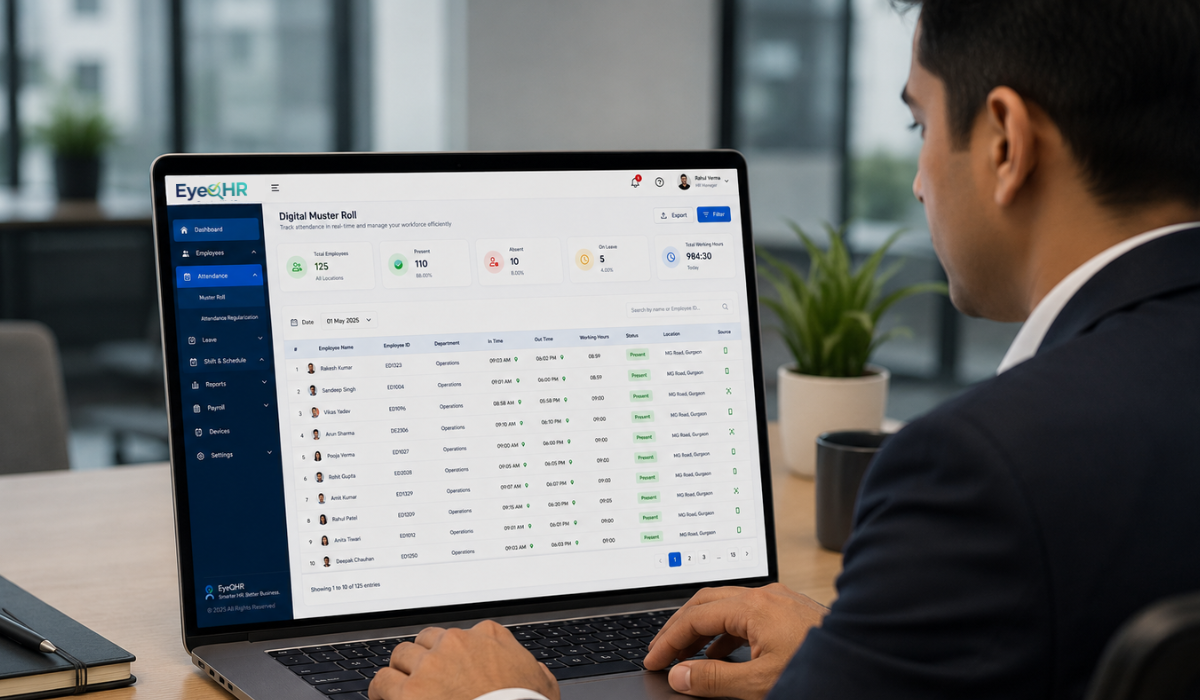
  • Attendance capture: For field workers, GPS-based mobile check-in with geo-fencing replaces paper muster rolls and WhatsApp messages. Attendance data is captured on-site, not reconstructed in the office days later.
  • Payroll processing: Daily wages are calculated from actual attendance at the correct rate for each worker’s state and job category. PF, ESIC, and professional tax deductions are applied automatically.
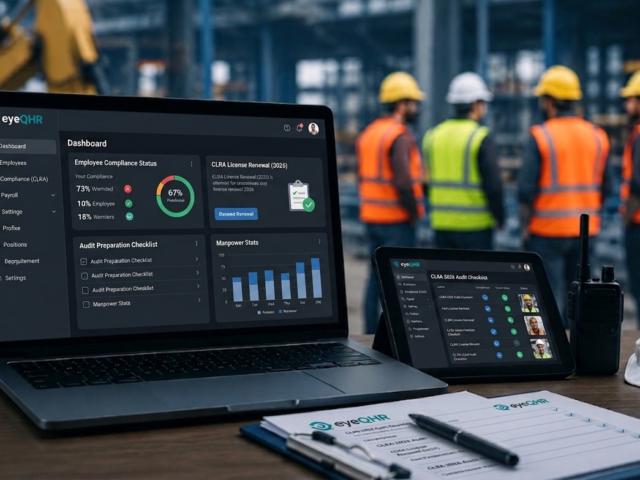
  • CLRA compliance: Muster rolls in Form XVI, wage registers in Form XVII, and other prescribed registers are generated directly from the system. No separate data entry, no manual filling.

The Real Cost of Managing Contract Labour Without Software

Most manpower companies underestimate this cost because it does not show up as a line item. It shows up as time, errors, and occasional penalties that seem unrelated to each other.

  • Payroll processing time: A payroll team handling 300 contract workers manually typically spends 3 to 4 full days at month-end. That is 40 to 50 working hours spent on calculation, not on people management.
  • Payroll errors and corrections: Manual wage calculation has an industry-average error rate of 1 to 3 per cent. At 300 workers, that is 3 to 9 incorrect payslips per month. Each correction takes 30 to 60 minutes and damages trust with the affected worker.
  • Compliance penalties: A missed PF deposit or an incomplete muster roll during a CLRA inspection can result in fines, notices and in serious cases, suspension of your contractor licence.
  • Client billing disputes: Without clean site-wise attendance data, billing disputes with principal employers take days to resolve. With a digital trail, the same dispute takes minutes.
  • Staff attrition risk: Workers who receive late or incorrect wages leave. In security and facility management, high attrition means constant recruitment costs and skill gaps at client sites.

How Different Manpower Verticals Use the Software

1. Staffing agencies

Staffing agencies typically manage a high volume of short-tenure placements across many client organisations. The most critical features are rapid worker onboarding, contract management, and the ability to generate compliance reports separately for each principal employer.

2. Security companies

Security deployments run 24 hours across multiple shifts. The key requirements are shift-based attendance tracking, accurate overtime calculation for guards working extended shifts, and management of night shift allowances. GPS attendance is particularly important because security guards cannot report to a central location to check in.

3. Facility management companies

Facility management operations involve workers at many different client buildings, often in different cities. Site-wise workforce management, multi-state minimum wage compliance, and the ability to give site supervisors limited access to manage their own teams are the priority features.

4. Labour contractors

Labour contractors supplying workers to construction, manufacturing, or logistics clients need strong CLRA compliance features, daily wage and overtime calculation, and the ability to run payroll separately for each principal employer for billing purposes.

What to Look for When Evaluating Software in 2026

  • Does it support daily-wage payroll natively? Ask the vendor to show you a payroll run for 200 daily-wage workers with three different state wage rates.
  • Does it generate CLRA registers automatically? The muster roll and wage register should come directly from attendance and payroll data. If the answer involves exporting to Excel first, that is a compliance gap.
  • Does the attendance system work without hardware at client sites? GPS geo-fencing on a mobile app is a practical solution for field deployments.
  • Can it handle multi-state minimum wage compliance? The system should hold current wage rates for each state and apply the correct rate based on where the worker is deployed.
  • What is the implementation timeline? A platform built for the manpower industry should have you running core payroll and attendance within days, not months.

How EyeQHR Fits the Manpower Company Use Case

EyeQHR was built specifically for the operational reality of Indian manpower companies. That means bulk payroll for daily-wage and contract workers, GPS attendance with geo-fencing for field staff, CLRA compliance registers generated automatically, and multi-site workforce management as standard features, not add-ons.

Setup takes days, not months. No IT team is required. And the pricing model works for high-volume, lower-margin businesses like manpower and security companies, not just enterprise technology firms.

Frequently Asked Questions

Q1. Is contract labour management software different from regular HR software?

A1. Yes. Regular HR software is built for permanent, salaried employees in one location. Contract labour management software is designed for variable-attendance workforces deployed across multiple client sites, with support for daily wages, CLRA compliance registers, and field attendance tracking.

Q2. Does contract labour management software help with CLRA audits?

A2. A well-built system generates all the registers required under CLRA, including the muster roll in Form XVI, the wage register in Form XVII, and employment cards. These are generated directly from attendance and payroll data rather than being filled separately.

Q3. How many workers can the software handle?

A4.Platforms built for the manpower industry typically handle workforces from 50 to several thousand workers. The key is whether the payroll processing is genuinely batch-capable. Ask the vendor how long a payroll run takes for your specific headcount.

Q4. Can we use it for both permanent staff and contract workers?

A4. Yes. Most purpose-built manpower HRMS platforms support multiple employment types. Permanent staff on monthly salaries and contract workers on daily wages can be managed in the same system with different payroll rules applied to each group.

Related Posts

Minimum Wage India 2026 for Contract Workers: State-Wise Rates, Daily Wage Calculation, and Compliance Guide

Minimum Wage India 2026 for Contract Workers: State-Wise Rates, Daily Wage Calculation, and Compliance Guide

State governments revise minimum wages twice a year. Most manpower companies update their payroll rates once, when they receive a…
Read More
Attendance Management for Manpower Companies: Why Your Current System is Failing You and What to Do About It

Attendance Management for Manpower Companies: Why Your Current System is Failing You and What to Do About It

A security company in Jaipur was managing attendance for 340 guards across 22 client sites using WhatsApp messages and paper…
Read More

Daily Wage and Overtime Calculation for Contract Workers in India: Complete Formula Guide

Daily Wage and Overtime Calculation for Contract Workers in India: Complete Formula Guide

Calculating daily wages and overtime for contract workers sounds straightforward until you actually sit down to do it. The daily…
Read More
Why Contract Labour Management Software is Non-Negotiable for India’s Manpower Industry in 2026

Why Contract Labour Management Software is Non-Negotiable for India’s Manpower Industry in 2026

If you run a manpower company, staffing agency, or security firm in India, you already know that managing contract labour…
Read More

Muster Roll Format India: What It Is, What Goes in It, and How to Maintain It Correctly

Muster Roll Format India: What It Is, What Goes in It, and How to Maintain It Correctly

Every manpower company, labour contractor, and staffing agency that deploys workers under the Contract Labour (Regulation and Abolition) Act, 1970…
Read More

PF and ESI for Contract Workers in India: A Practical Guide for Manpower Companies

PF and ESI for Contract Workers in India: A Practical Guide for Manpower Companies

Provident Fund and ESIC are among the most commonly misunderstood compliance obligations for manpower companies. Not because the rules are…
Read More
What to Look for in an HRMS for Manpower Companies India 2026: The Complete Buyer’s Guide

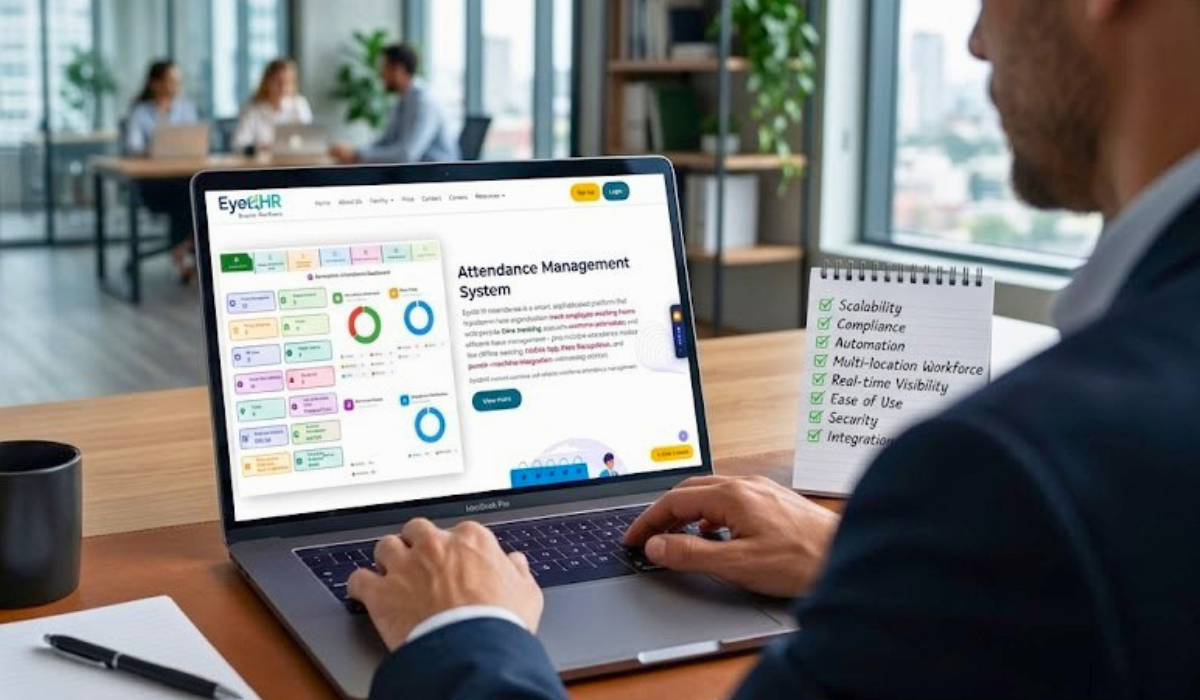
What to Look for in an HRMS for Manpower Companies India 2026: The Complete Buyer’s Guide

Finding the right HRMS for a manpower company in India is a very different exercise from choosing HR software for…
Read More

How to Run Bulk Payroll for Contract Workers in India: A Step-by-Step Guide

How to Run Bulk Payroll for Contract Workers in India: A Step-by-Step Guide

Running payroll for a fixed workforce of salaried employees is relatively straightforward. Running bulk payroll for contract workers is a…
Read More

Field Employee Attendance Tracking: A Complete Guide for Manpower, Security, and Facility Management Companies

Field Employee Attendance Tracking: A Complete Guide for Manpower, Security, and Facility Management Companies

Ask any HR manager at a manpower company what their most time-consuming problem is, and attendance will come up in…
Read More

Minimum Wage India 2026: State-Wise Updated Rates and Daily Wage Calculation Guide

Minimum Wage India 2026: State-Wise Updated Rates and Daily Wage Calculation Guide

Minimum wage compliance is one of the most consistent pain points for manpower companies, staffing agencies, and any business that…
Read More

CLRA Compliance Checklist for Manpower Companies in India: What You Must Get Right in 2026

CLRA Compliance Checklist for Manpower Companies in India: What You Must Get Right in 2026

Every manpower company in India that deploys contract workers has legal obligations under the Contract Labour (Regulation and Abolition) Act,…
Read More